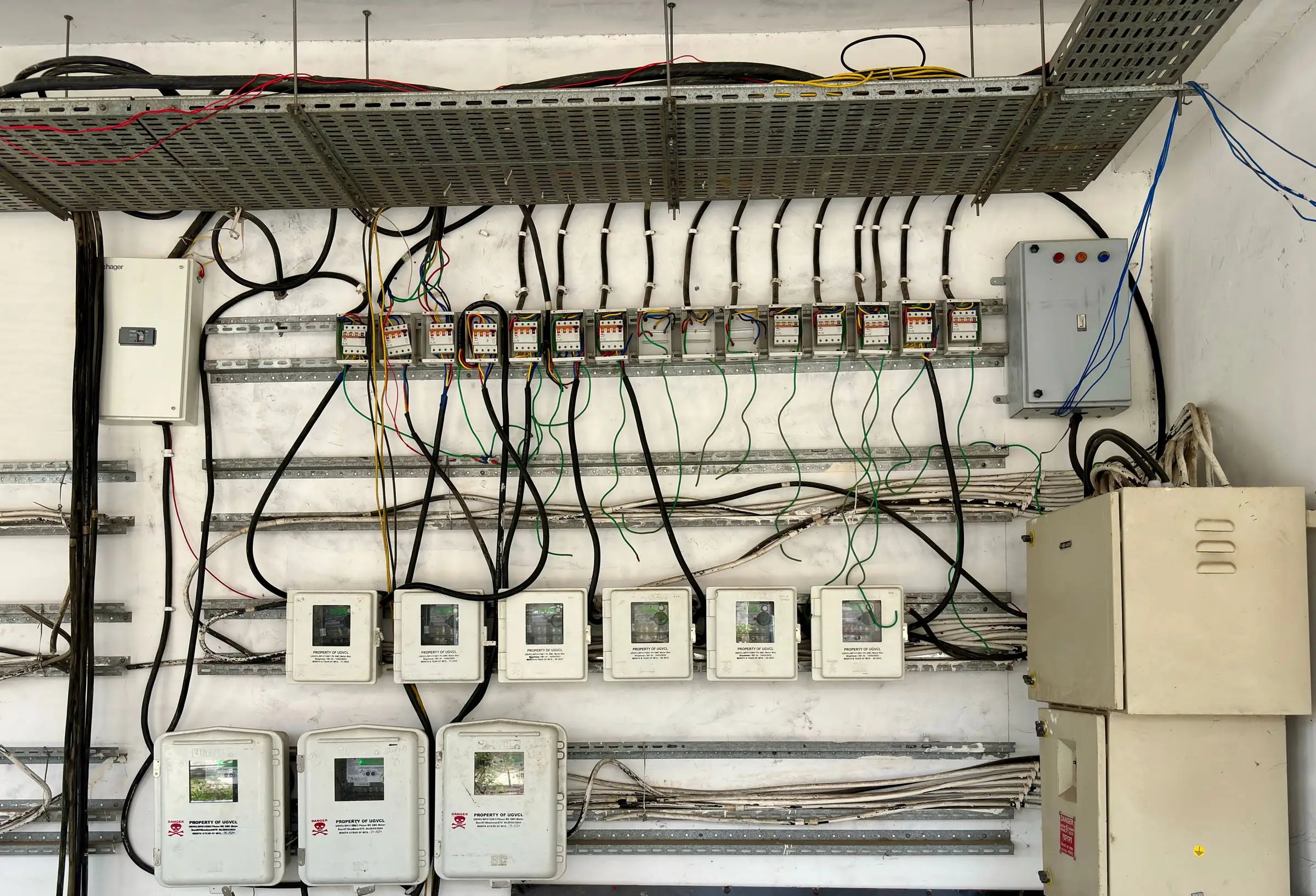
House Rewiring Cost by scope, house area and quality tier
The wire is a rounding error. What it costs to reach every circuit, and to close the walls again, is the quote.
What rewiring a house costs
Rewiring a house runs $4,000 – $30,000, and the scope decides almost all of it. A partial rewire that touches the kitchen, the bathrooms and the circuits that fail code is a fraction of a full replacement, and a knob-and-tube removal is the most expensive version of the same work.
Rewiring is priced per square foot of the area the wire has to reach, then adjusted for how hard that area is to open. Drywall gives up its cavities easily; plaster and lath does not, and a finished basement below the run turns an easy pull into a demolition.
This guide takes the number apart. It prices each scope per square foot, scales it by house area, splits the bill into materials and labor, and lists what follows: the panel upgrade, the drywall repair, the code-required devices and the circuits an older house never had.
Nothing here asks for your address or your phone number. When you want real quotes, the checklist near the bottom tells you what a serious one has to contain, starting with the permit.
What each rewiring scope costs
Installed cost per square foot of house, covering wire, boxes, devices and labor for the scope named. The total column prices each scope across 1,800 sq. ft., roughly a three-bedroom house.
| Material | Installed cost per square foot, installed | Lifespan | On the worked example | Who it suits |
|---|---|---|---|---|
| Partial rewire | $2 – $6 | 40 – 70 years | $3,600 – $10,800 | Kitchen, baths and the circuits that actually fail code, left in walls that mostly stay closed. The pragmatic scope on a house that is otherwise sound. |
| Full rewire | $5 – $17 | 50 – 70 years | $9,000 – $30,600 | Every circuit replaced back to a new panel. The house is opened room by room, which is why the drywall trade follows the electrician everywhere. |
| Aluminum branch remediation | $6 – $17 | 50 – 70 years | $10,800 – $30,600 | The 1960s and 1970s problem. Either every branch circuit is replaced, or every connection is pigtailed with an approved connector, and insurers care which. |
| Knob-and-tube replacement | $8 – $20 | 50 – 70 years | $14,400 – $36,000 | Pre-war wiring with no ground, often buried under insulation that should never have covered it. The most expensive rewire because the demolition is the job. |
These scopes are not interchangeable. A partial rewire is a targeted fix on a house that is otherwise sound; knob-and-tube removal is a demolition project with an electrician attached, and the difference is the wall, not the wire.
How house size changes the rewiring cost
The same full rewire priced across the house sizes most projects fall into. Cost scales close to linearly, because every additional square foot is another length of wall to open, route and close.
| House area | Project cost mid-range full rewire |
|---|---|
| 1,000 sq. ft. | $8,000 – $14,000 |
| 1,500 sq. ft. | $12,000 – $21,000 |
| 1,800 sq. ft. | $14,400 – $25,200 |
| 2,500 sq. ft. | $20,000 – $35,000 |
| 3,500 sq. ft. | $28,000 – $49,000 |
Count the area the wire actually has to reach, including a finished basement or a converted attic. Unfinished space that still carries circuits is cheaper per foot but it is not free.
Economy, mid-range and premium rewiring costs
The same full rewire at three levels of specification and workmanship, on an 1,800 sq. ft. house. The bands overlap because real quotes do, and because most of the difference is device count rather than wire.
| Tier | Per unit | Project cost on 1,800 sq. ft. | What it buys |
|---|---|---|---|
| Economy | $5 – $9.20 | $9,000 – $16,600 | Builder-grade product, a crew working fast, and the simplest version of the job. Buys the function, not the finish. |
| Mid-range | $8 – $14 | $14,400 – $25,200 | What most homeowners actually sign. Mid-tier product from a named manufacturer, a licensed crew, and a warranty worth reading. |
| Premium | $12.20 – $17 | $22,000 – $30,600 | Top of the product line, specialist installers, and the detailing that decides how the job looks in year fifteen. |
What the tier buys is outlets and circuits: how many, how well distributed, and how many dedicated. An older house rewired to the minimum passes inspection and still leaves you running extension cords, which is the complaint every homeowner has after a cheap rewire.
Wiring materials versus electrician labor
On a full rewire of an 1,800 sq. ft. house, $14,400 – $25,200 before add-ons, the bill divides like this.
- Materials $4,300 – $7,600
- 30% of the bid Cable, boxes, breakers, receptacles, switches, the panel if it is being replaced, and the smoke and carbon monoxide alarms code now requires.
- Labor and overhead $10,100 – $17,600
- 70% of the bid Opening walls and ceilings, routing every circuit, terminating each device, labelling and testing the panel, the permit and inspection, and the debris that leaves with the crew.
Labor dominates, and most of that labor is access rather than electrical work. It is why the same house costs so differently depending on whether it is drywall or plaster, single story or three, and open framed or fully finished below.
What gets added to an electrical quote
Three line items as a share of the base. The second moves most between the first estimate and the final plan.
| Line item | Surcharge share of the base cost | On the example | What it covers |
|---|---|---|---|
| Service and panel upgrade to 200 A | +15% – 45% | $2,200 – $11,300 | New panel, breakers, meter base and grounding, plus the utility coordination. Assume it on any house still on 100 amps that is adding load. |
| Drywall repair and repainting | +15% – 40% | $2,200 – $10,100 | Every circuit pulled means a wall opened. Like a repipe, the electrician leaves holes and a second trade closes them. |
| Plaster and lath, or finished basement | +10% – 35% | $1,400 – $8,800 | Old plaster does not patch like drywall, and a finished ceiling below the run turns an easy pull into a demolition. |
| Code-required devices | +5% – 20% | $700 – $5,000 | Arc-fault and ground-fault protection, tamper-resistant receptacles, smoke and carbon monoxide alarms interconnected as current code demands. |
| EV charger circuit | +5% – 20% | $700 – $5,000 | A dedicated 240 volt circuit to the garage or driveway. Cheap while the walls are open, expensive as a separate visit later. |
| Added outlets and fixtures | +5% – 25% | $700 – $6,300 | The outlets an older house never had, plus lighting changed while the ceiling is open. Priced per device by careful bidders. |
| Permits and inspection | +3% – 8% | $450 – $2,000 | Non-negotiable on electrical work. It is also the only independent check that what is now inside the walls is safe. |
Two of these are far cheaper now than later. A 240 volt circuit to the garage costs a fraction while the walls are open, and so does every outlet you wish the house had. Both are separate visits and separate mobilisations once the drywall is closed.
How location affects rewiring cost
Electrical work is licensed labor at local rates, and inspection regimes differ by jurisdiction. These are indicative multipliers on the national figure, not local quotes.
| Region | Multiplier | Project cost on the worked example | Why it moves |
|---|---|---|---|
| Northeast | 1.10× – 1.25× | $15,800 – $31,500 | Highest labor rates in the country, older housing stock, and snow-load requirements that add material. |
| West | 1.05× – 1.30× | $15,100 – $32,800 | Wide internal spread. Coastal metros price like the Northeast; the interior sits near the national middle. |
| Midwest | 0.92× – 1.05× | $13,200 – $26,500 | Closest to the national number. Deep contractor supply keeps competitive pressure on quotes. |
| South | 0.85× – 1.00× | $12,200 – $25,200 | Lowest labor cost, but storm exposure raises material specification and insurance-driven demand spikes. |
Code adoption is the local variable that matters most here. Two jurisdictions on different code cycles require different device counts and different protection, and that is a specification difference rather than a market one.
How to read an electrical quote
This is the trade where the work disappears behind a wall and only an inspector ever sees it. These two lists separate a quote worth taking seriously from one that will pass a glance and fail a decade.
Red flags
Walk away from an electrical quote if
- There is no permit line, or the permit is described as optional.
- The electrician’s license number and insurance are not offered when asked.
- The quote does not say how many outlets and circuits are included.
- Nothing is said about who repairs the walls afterwards.
- The existing panel is not assessed, or its capacity is not stated.
- Arc-fault and ground-fault protection are absent from the specification.
- The price is dramatically below the others, which usually means fewer devices rather than better value.
Questions
Ask every electrician
- What scope are you quoting: partial, full, or removal of a specific wiring type?
- How many circuits, outlets and dedicated lines does that include?
- What is the panel capacity now, and does this work require an upgrade?
- How will you route circuits through plaster or a finished basement?
- Does this price end at inspection, at patched walls, or at paint?
- Which code cycle is my jurisdiction on, and what does it require here?
- How long is the house without power, and on which circuits?
What homeowners ask about rewiring cost
Why do rewiring quotes vary so much on the same house?
Because they include different numbers of devices and different amounts of restoration. A quote with the minimum outlets and no drywall repair will always undercut one that leaves the house usable and painted, and only one of them is a finished job.
What does a panel upgrade cost on its own?
A 200 amp service upgrade generally runs a few thousand dollars including the panel, breakers, meter base and permit. Done during a rewire it is a fraction of that, because the electrician and the utility coordination are already on site.
Do I have to rewire the whole house at once?
No. Staging by circuit is legitimate: kitchen and bathrooms first, since they carry the load and the code requirements. Each stage repeats the setup, so expect the total to run higher than doing it in one pass.
Will my insurer require a rewire?
Increasingly, on knob-and-tube and sometimes on aluminum branch wiring. Some carriers decline to write a policy at all; others require documented remediation. Check with your insurer before you scope the work, because it may change what has to be done.
How long does a rewire take?
Roughly a week to two weeks of electrical work on a typical house, plus the drywall and paint that follow. Power comes back circuit by circuit rather than all at once, so plan for partial service rather than no service.
Is it worth adding an EV circuit while rewiring?
Almost always. A dedicated 240 volt run to the garage costs a small share of the job while the walls are open, and a standalone installation later costs several times that, plus a second permit.
Figures on this page are indicative national brackets, not quotes. Your number depends on the size, complexity and condition of the job itself, and on what local crews are charging when you buy. Use them to judge a bid, not to replace one.
Cost data
- HomeGuide, How much does it cost to rewire a house? (opens in a new tab) Checked August 11, 2026
- Angi, Cost to rewire a house (opens in a new tab) Checked August 11, 2026
- HomeGuide, Cost to replace knob and tube wiring (opens in a new tab) Checked August 11, 2026
Projects that pair with a rewire

The calculator prices rewiring per square foot on the same national data as every table on this page; no phone number, no lead form.
Price it by the scope Before the first quote